Jago Grahak Jago

Edit Template

Expert panel urges drug regulator to approve Lilly’s obesity drug Mounjaro

July 01,2024 Hyderabad: An Indian government-approved expert panel has advised the country’s drug regulator to approve the import and sale of U.S. drugmaker Eli Lilly’s Mounjaro, a blockbuster diabetes drug and a wildly popular obesity treatment, a document on a government website showed on Monday. Lilly’s Mounjaro, chemically known as tirzepatide, and Zepbound and Danish rival Novo Nordisk’s Wegovy and Ozempic belong to a class of therapies known as GLP-1 receptor agonists, developed to control blood sugar in patients with type 2 diabetes. They also slow digestion, helping patients feel full longer, making them a wildly popular choice for weight loss. “After detailed deliberation, the committee recommended for grant of permission for import and marketing” of certain doses of tirzepatide “for chronic weight management subject to the condition that firm should conduct Phase 4 clinical trial (post-marketing surveillance),” the Subject Expert Committee said in a notification dated June 19. The committee advises India’s drug regulator on approvals of drugs and trials. “A recommendation from the subject expert committee is like the penultimate step of the approval,” said Sheetal Sapale, vice president of research firm Pharmarack. Lilly did not immediately respond to a Reuters request for comment. CEO David Ricks had told Reuters a few months back that the company expected to launch Mounjaro in India as early as next year. India has the world’s second-highest number of people with type 2 diabetes and high obesity rates. Around 11% of Indian adults will be obese by 2035, per the World Obesity Federation Atlas. The global weight-loss drugs market is estimated to reach at least $100 billion by the decade’s end. Lilly should also submit the required manufacturing and controls data, the expert panel added. The notification was first reported by a local medical journal, The Indian Practitioner. (Reporting by Rishika Sadam; Editing by Dhanya Skariachan and Savio D’Souza) Source: Pharma

Expert panel urges drug regulator to approve Lilly’s obesity drug Mounjaro Read More »

Wegovy, Ozempic linked with sight-threatening eye disorder in study

July 04,2024 London: Patients using Novo Nordisk’s wildly popular weigh-loss drug Wegovy and its similar medicines for type 2 diabetes may be at increased risk for a sight-threatening eye condition, according to data from a study published on Wednesday. Wegovy and Novo’s diabetes drugs Ozempic and Rybelsus all contain the same active ingredient, semaglutide, and belong to a class of medications known as GLP1 receptor agonists. The rate of the eye problem known as nonarteritic anterior ischemic optic neuropathy, or NAION, was 8.9% for those taking semaglutide for type 2 diabetes, compared with 1.8% for patients taking non-GLP-1 diabetes medications, researchers reported in JAMA Ophthalmology. Among those prescribed semaglutide for overweight or obesity, the rate of the eye condition was 6.7%, versus 0.8% for those receiving other types of medications for weight reduction. The 36-month observational study involved 710 adults with type 2 diabetes and 979 taking medications for weight loss. NAION develops from insufficient blood flow to the optic nerve and causes sudden painless vision loss in one eye. It is the second most common cause of blindness due to optic nerve damage, after glaucoma. After taking patients’ other risk factors for the condition into account, such as high blood pressure and obstructive sleep apnea, use of semaglutide was associated with a more than four times higher risk of NAION in those receiving it for diabetes and a more than seven times higher risk in patients taking it for obesity. Novo Nordisk in an emailed statement noted several limitations of the study design, which was not a randomized controlled trial. “Overall, the data published in the study is not sufficient to establish a causal association between GLP-1 receptor agonist use and NAION,” the Danish drugmaker said, adding that the condition “is not an adverse drug reaction for the marketed formulations of semaglutide.” NAION more often affects older individuals. In the overall U.S. population, the estimated annual incidence is 0.54 per 100,000 people, rising to 2.3 to 10.2 per 100,000 in adults above age 50, according to the American Academy of Ophthalmology. The prognosis for visual recovery is better for younger patients, the AAO says. Mean ages in the study were 46 among patients using semaglutide for obesity and 57 among those using it for diabetes. “This work has been carried out to a high level of quality and… does suggest an association between semaglutide treatment and one form of sight-threatening optic neuropathy, but this would ideally be tested in larger studies,” Graham McGeown of Queen’s University Belfast, who studies diabetic eye disease but was not involved in the new research, said in a statement. “Given the rapid increase in semaglutide use and its possible licensing for a range of problems other than obesity and type-2 diabetes, this issue deserves further study, but possible drug side effects always need to be balanced against likely benefits,” McGeown said. The researchers involved in the study were not immediately available to comment on their findings. Source: Healthworld

Wegovy, Ozempic linked with sight-threatening eye disorder in study Read More »

DCGI inspection brings curtains down on 36% of 400 pharma units; plans for new digital projects

June 27,2024 Mumbai: The Drug Controller General of India (DCGI) Rajeev Raghuvanshi on Thursday revealed that the Central Drugs Standard Control Organization (CDSCO) has conducted risk-based inspections of over 400 pharmaceutical manufacturing units over the past year and a half, resulting in the closure of 36% of these facilities. “We have been successfully doing risk-based inspections and inspected about 400 manufacturing units and I am not very happy to say that more than 36% of them had to be closed because there was a reason to close them,” Raghuvanshi said at an Indian Pharmaceutical Alliance (IPA) event. “These MSMEs had to shut down as they realised that they cannot meet the expectations of the regulators.” As the quality assurance of drugs manufactured in the country continues to be a cause of concern, CDSCO is about to start four key projects that will help the Indian pharmaceutical industry to continue improving and maintaining the quality of the drugs coming out of India, the ‘pharmacy capital of the world’. One of the four projects, the regulatory body CDSCO will be coming out with is a digital platform—Digital Drug Regulatory System, he said. “So four big-ticket projects are in the pipeline and one of them we are coming out with is our digital platform, which would cover the complete regulatory value chain in this country,” said Raghuvanshi. The organisation plans to structure the platform in a way that brings aboard all the stakeholders involved in the industry from regulatory bodies to manufacturers and retailers. “Each and every stakeholder, government, private, semi-government, whoever has any stake in the regulatory value chain would be brought onto that platform. And so, you have solutions to all kinds of quality issues. We are waiting on the final approval from the government but to design this we have already floated the RFP and the final tender is yet to be done,” he added. Raghuvanshi then disclosed the second project the organisation is working on – the regulatory rationalisation initiative, under which CDSCO has hired two internationally renowned consultancy organisations. One of the two consultancy firms is tasked to look at CDSCOs’ internal process, while the second one will take a look at The Drugs and Cosmetics Act, 1940 and rules to rationalise while removing the redundancies and simplifying the whole regulation. The first one he disclosed will start its working from 1 July while the second one will begin its work in a couple of weeks time. “Third being, increasing the internal scientific cadre at CDSCO. Unfortunately today there is not a single scientific cadre to do an internal review of the files, which the stakeholders are not comfortable with. So we are initiating a process to get the internal scientific cadre at CDSCO so that more than 50-60% of the activities of the final review can happen internally,” he continued. Finally the fourth project, Raghuvanshi added, is not part of the CDSCO but for the Indian Pharmacopoeia Commission (IPC) to set up the Digital IP. IPC is an autonomous institution of the Ministry of Health and Family Welfare committed to ensuring quality and safety of drugs. “The product is in its final stages and will be in use by the next month as it is under final testing,” he added. Raghuvanshi is also the secretary-cum-scientific director of IPC. Source: Livemint

DCGI inspection brings curtains down on 36% of 400 pharma units; plans for new digital projects Read More »

52 drug samples fail regulatory body’s quality test

June 26,2024 New Delhi: India’s apex drugs regulatory body has found the samples of around 50 drugs, including that of widely-used paracetamol, pantoprazole and some antibiotics for treating bacterial infections, as not of standard quality. Of these sub-standard drugs, 22 are manufactured in Himachal Pradesh, according to the alert issued by the Central Drugs Standard Control Organisation (CDSCO) for the month of May. Besides Himachal Pradesh, the samples were collected from Jaipur, Hyderabad, Waghodia and Vadodara in Gujarat , Andhra Pradesh and Indore, among other places. A total of 52 samples have failed the quality test conducted by the CDSCO, according to the drug alert issued on June 20. Sources said state drug regulators have reportedly sent notices to the pharmaceutical companies concerned and the failed samples would be recalled from the market. The list of the sub-standard drugs contains Clonazepam tablets that are used to treat seizures and anxiety disorders, pain reliever Diclofenac, anti-hypertension drug Telmisartan, Ambroxol, which is used in the treatment of respiratory diseases, Fluconazole, an antifungal, and some multivitamin and calcium tablets. The samples of around 120 drugs manufactured in Himachal Pradesh had failed the test parameters last year. Source: Pharma

52 drug samples fail regulatory body’s quality test Read More »

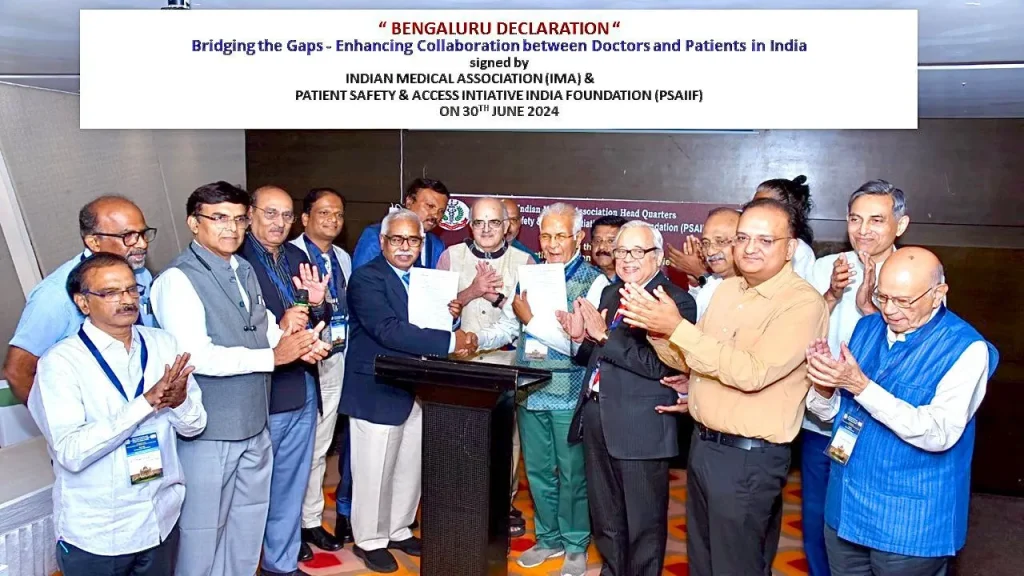
Landmark Declaration Between IMA and PSAIIF on Advancing Health Insurance, Data Protection and Universal Healthcare in India

Landmark Declaration Between IMA and PSAIIF on Advancing Health Insurance, Data Protection and Universal Healthcare in India

A momentous two-day meeting on ‘Bridging the Gaps – Enhancing Collaboration between Doctors and Patients in India’ took place between the Indian Medical Association (IMA) and the Patient Safety & Access Initiative of India Foundation (PSAIIF) in Bengaluru, Karnataka on 29-30June, 2024. 21 representatives each of IMA and PSAIIF deliberated in a series of 3 sessions on three critical aspects of healthcare in India: Universal Healthcare, Confidentiality & Data Protection, and Developing a Health Insurance India Centric Model.

Landmark Declaration Between IMA and PSAIIF on Advancing Health Insurance, Data Protection and Universal Healthcare in India Read More »

Edu Tap fined Rs 3 lakh for misleading RBI Grade B exam ads

June 13,2024 The Central Consumer Protection Authority (CCPA) has slapped a penalty of Rs 3 lakh on edtech firm Edu Tap Learning Solutions for misleading advertisements claiming 144 students were selected for the RBI Grade B exam in 2023 after taking its courses. In an order issued on June 12, the CCPA directed Edu Tap to immediately discontinue the “impugned advertisement” from all electronic and print media. The company has been given 15 days to submit a compliance report. The consumer watchdog found that Edu Tap’s advertisements on its YouTube and Telegram channels showcased the names and pictures of 144 candidates selected for the coveted RBI exam. However, it concealed crucial details about which specific courses these candidates had taken from the platform. As per CCPA’s findings, 57 out of the 144 candidates had taken only the ‘Interview Guidance Course’ offered free of cost by Edu Tap. This course comes into play after a candidate has cleared the RBI Grade B exam’s preliminary and main stages. The CCPA order noted that Edu Tap had “deliberately concealed important information” about the type and duration of courses opted by the successful students in a bid to “mislead consumers as a class.” The regulator took objection to Edu Tap using the RBI’s emblem in the advertisements without permission to lend them an “air of authenticity.” With around 2 to 2.5 lakh candidates appearing for the RBI Grade B exam annually, the CCPA underlined that the “vulnerability of the class of persons likely to be adversely affected by such misleading advertisements is huge.” Edu Tap has a sizeable presence with 3.59 lakh subscribers on YouTube and around 15,000 paid users across platforms. The company did not offer an immediate comment on the CCPA order when contacted. Source: Economic Times

Edu Tap fined Rs 3 lakh for misleading RBI Grade B exam ads Read More »

How to prevent Big Tech dominance, protect privacy and ensure fair competition

June 13,2024 In 2008, YouTube ran an animation video in which a man who signed up for a free service called ‘Google Toilet’ is seen sitting on a commode, while the smart pot projects ads on the wall in front of him by detecting his food preferences from his excreta and displays his social media status based on his toxicology report. Ultimately, paramilitary forces storm the lavatory and arrest him because the government has taken exception to his deviant food habits. When he protests against this invasion of his privacy and invokes the Bill of Rights, confirming that the scene is set in the US, he is told that he has nobody to blame but himself because by signing up for a free smart commode, he joined the Google Toilet network embedded with secondary disclosure agreements. Counter-arguments, on the other hand, presented by SSDEs (systemically significant digital enterprises) – Alphabet, Meta, Amazon, et al – opposing the Bill are not particularly credible. These include the following notions: That removing self-preferencing – an online platform’s ability to promote its own products, or those of a related party, above that of others – creates customer dissatisfaction. This may have warranted due consideration if SSDEs were in the business of selling shaving foam. But the dominance of online platforms like Meta and Google in India is such that ex ante regulations become necessary to curb the existential threat posed by Big Tech with regard to the non-dominant and nascent digital ecosystem. Self-preferencing and exclusive tie-ups with shell entities improve user engagement and retention, but act as an addictive content loop the user cannot escape. This creates a restrictive trade practice that is difficult to reverse over time. That explicit user-verification measures drive consent fatigue and adversely impacts innovation. This argument favouring innovation over authorisation is outrageous. Current opt-in permissions don’t work. Studies show that, at 250 words per min, it would take at least 30 days each year to peruse end-user licence agreements. Thus, users provide consent without understanding future data utilisation objectives, while digital platforms continue to synchronously harvest personal data. This has forged many unfortunate, and irreversible, outcomes. Recently, New York City filed a lawsuit against Meta, Snapchat, TikTok and YouTube, claiming that their platforms were addicting and endangering children, and promoting unsafe behaviours. Litigation against Meta in 40 other US states allege the same. The magnitude, scale and speed at which such platforms operate demand ex ante regulation, if the real interests of consumers are to be protected. This argument is also without merit. Section 4 of the Competition Act suggests that actions are anti-competitive only if carried out by ‘a dominant entity in its relevant market’. Since the onus of proving dominance and identifying the relevant market rests with the regulator, enforcement proceedings are invariably delayed. In one instance, filed before CCI in 2018, involving abuse of dominance ‘by a licensable operating system (‘OS’) for smart mobile devices’, the case is yet to reach the Supreme Court. In another, the case has been in limbo for 11 years. In such cases, ex post redressal is untenable. And if these reality checks on what constitutes efficient ‘customer satisfaction’ and ‘customer convenience’ are not convincing enough, something more fundamental could make ex ante regulation necessary. As sole providers of public digital infrastructure, SSDE dominance can cause chaos through a single disruption. Meta’s deleterious effect in this regard is well known: its intentional blocking of social media in Australia, and disrupting fire services, health services and vaccine rollouts during the pandemic; its disruption of newsfeeds in 2018 in Bolivia, Slovakia, Sri Lanka, Serbia, Guatemala and Cambodia; and its part in precipitating the exodus of 70,000 Rohingya people, tantamount to subverting the machinery of law and order. As recently as April 2024, Google received authorisation to work with US intelligence and defence agencies, enabling them to use Google’s air-gapped cloud platform ‘to process top- secret workloads’. Given Google’s status as a foreign defence contractor that manages millions of records of sensitive data, can India really afford to oversee SSDEs by initiating the process of discovery and action after the fact? Protecting the welfare of citizens is the essence of national security. Protecting public interest, that of national sovereignty. Often at the expense of accelerated short-term growth. The Digital Competition Bill, which aims to contain matsyanyaya – a law, or absence thereof, which allows big fish to eat little fish – is the first step in this direction. Ultimately, GoI will need to decide if a billion ‘free smart toilets’ are worth any sort of compromise. Source: Economic Times

How to prevent Big Tech dominance, protect privacy and ensure fair competition Read More »

Housing Society Problems and Solutions: Legality of Committee Meetings Held Online; Challenging a Structural Audit

June 13,2024 Due to the complex nature of our jobs and other commitments in life, it may not always be possible for committee members of a cooperative housing society (CHS/Society) to be physically present for routine meetings. In fact, during the COVID-19 pandemic, the commissioner and registrar for cooperative housing societies in Maharashtra allowed meetings to be conducted online for convenience and to maintain social distancing.  Even today, housing society meetings can be conducted online, provided some committee members are physically present while others attend online via video. Other formalities, such as signing the attendance registrar or minutes book, can be completed once members visit the society office. I have explained this in detail in one of the concerns raised this week.  The validity of structural audits is another problem that we are looking at. Although not as common, there are cases when a structural audit done by the local municipal corporation needs independent verification through experts. I will explain the formalities in conducting such an independent verification as well. Legality of Committee Meetings Conducted Online Question:  Is it legal to conduct management committee meetings online, as most committee members are continuously travelling and it becomes difficult to set a date for physical meetings. Answer:  For convenience, a Society is allowed to conduct its meetings in a hybrid mode, where some of the committee members are physically present in the Society’s office and those that could not join have attended the meeting online through a video call. It is crucial, however, that at least one committee member is present for such a meeting physically at the Society’s office.  The meeting minutes need to mention who was present physically and who had joined online through a video call. Those who could not attend the meeting physically should sign the minutes book when they next have the opportunity to come to the Society’s office.  CONSUMER INTEREST Due to the complex nature of our jobs and other commitments in life, it may not always be possible for committee members of a cooperative housing society (CHS/Society) to be physically present for routine meetings. In fact, during the COVID-19 pandemic, the commissioner and registrar for cooperative housing societies in Maharashtra allowed meetings to be conducted online for convenience and to maintain social distancing.  Even today, housing society meetings can be conducted online, provided some committee members are physically present while others attend online via video. Other formalities, such as signing the attendance registrar or minutes book, can be completed once members visit the society office. I have explained this in detail in one of the concerns raised this week.  The validity of structural audits is another problem that we are looking at. Although not as common, there are cases when a structural audit done by the local municipal corporation needs independent verification through experts. I will explain the formalities in conducting such an independent verification as well. Legality of Committee Meetings Conducted Online Question:  Is it legal to conduct management committee meetings online, as most committee members are continuously travelling and it becomes difficult to set a date for physical meetings. Answer:  For convenience, a Society is allowed to conduct its meetings in a hybrid mode, where some of the committee members are physically present in the Society’s office and those that could not join have attended the meeting online through a video call. It is crucial, however, that at least one committee member is present for such a meeting physically at the Society’s office.  The meeting minutes need to mention who was present physically and who had joined online through a video call. Those who could not attend the meeting physically should sign the minutes book when they next have the opportunity to come to the Society’s office.  Independently Verifying Structural Audit Report Question: Our building has been declared as dilapidated under C1 category by the Thane Municipal Corporation (TMC). The structural report for our building was prepared by an auditor who was compliant and registered with the TMC. In my humble opinion, the structure of our building is stable and I genuinely believe that we should be in the C3 category. Is there an opportunity to get a second opinion for a structural audit of our building, perhaps from Veermata Jijabai Technological Institute (VJTI) or the Indian Institute of Technology Bombay (IIT-B)? Will I need a no objection letter/certificate (NOC) from the Society to undertake such a task? I would be willing to cover the audit expenses if the Society refuses to do so. Please advise.  Answer: To challenge the TMC structural report and consult either VJTI or IIT-Bombay, you do not need to obtain an NOC from the Society. You can simply take TMC’s structural report and inform TMC in writing that you want to verify their structural report through experts from VJTI or IIT-Bombay. Mention in this letter that TMC should not take any action based on their structural report until the independent verification is done. You should also write a similar letter to your Society informing them to withhold any action until the structural audit is independently verified. Kindly consult the appropriate authorities at either VJTI or IIT-Bombay regarding the charges for such an audit. You may then write a formal letter and share a copy of the structural report with your chosen independent expert. A NOC from the Society is not required for this process.  Question: My unmarried brother passed away recently and I am the only surviving sibling. I now want to claim my share in his property. However, one of our nieces has claimed that she is a nominee in the concerned flat and that the entire share should go to her. The secretary of the Society refuses to share any details of the flat on request and has also refused to give me an appointment to meet. How can I acquire details of the flat? Will filing an RTI application with the deputy registrar help me in any way? Please guide.  Answer: I hope you have submitted

Housing Society Problems and Solutions: Legality of Committee Meetings Held Online; Challenging a Structural Audit Read More »

Auto-renewal of Term Deposits: A Convenient Trap for Unclaimed Funds?

June 14,2024 When you read this news, RBI Slaps Rs11.50 Lakh Penalty on 3 Cooperative Banks from Uttar Pradesh, you think the regulator penalises the banks that are non-compliant in transferring the unclaimed deposits to the depositor education and protection fund (DEAF) within the prescribed period. It may be a shock of the day if you come to know that there is a loophole in the system which paves the way for the banks to perpetually renew the term deposits and they never need to transfer them to unclaimed deposits to DEAF. This article delves into the ambiguity and inadequacy in the regulatory guidelines. Important regulatory guidelines on inoperative accounts and unclaimed deposits 1. RBI has explained the need for proper control and monitoring of unclaimed deposits through a press release dated 22/07/2022  2. RBI has taken a significant step towards consolidating and rationalising the framework governing inoperative accounts and unclaimed deposits. On 1 January 2024, RBI issued a comprehensive set of instructions, under the circular (RBI/2023-24/105 DOR.SOG (LEG).REC/64/09.08.024/2023-24), which aims to streamline the classification and activation processes for such accounts. The extant guidelines of RBI (including the above two) do not touch on auto-renewal of term deposits continuously by the banks. There are certain provisions in the master directions issued by RBI which are ambiguous and are conveniently (mis)interpreted by banks in perpetually enjoying the funds of the customers. A peculiar provision most misinterpreted Master directions on the interest rate on deposits issued by RBI provide the following guidelines about renewal of overdue deposits. 2.13. Renewal of overdue deposits All aspects concerning renewal of overdue deposits may be decided by individual banks subject to their board laying down a transparent policy in this regard and the customers being notified of the terms and conditions of renewal including interest rates, at the time of acceptance of a deposit. The policy should be non-discretionary and non-discriminatory. Based on the above master directions, most of the banks have a board-approved policy on the renewal of overdue deposits on the similar lines given below. Unless there are specific instructions to the contrary, term deposits will be renewed for the same tenure as was for the matured term deposit and rate of interest would be as prevailing on due date. The conundrum of auto-renewal A common practice among many Indian banks is the auto-renewal of term deposits on maturity, especially in the absence of explicit depositor instructions. This policy, while convenient for maintaining the continuity of investments, raises a critical question in light of the RBI’s new guidelines: Can term deposits be perpetually renewed, and if so, do they ever get classified as unclaimed deposits? Present term deposit policy of banks explained For instance, a depositor has made a term deposit on, say, 15 February 2012, for a period of three years and the deposit matures for payment on 15 February 2015. On the date of maturity, the depositor has the following three options. a) To close/ redeem the deposit fully on the maturity date and get the proceeds. b) Renew the deposit (matured amount) fully for a further period of his choice. c) Renew part of the maturity amount and get back the balance amount to his savings bank (SB) account Suppose he does not exercise any of the above options, the bank shall renew the deposit automatically for a further period as the original deposit, i.e., three years. The maturity date of the renewed deposit shall be 15 February 2018. This auto-renewal shall continue unless the depositor gives any instruction to the contrary. The deposit shall be again renewed on 15 February 2018, 15 February 2021, 15 February 2024 and so on. Here is an important question What will happen in the following circumstances? (only illustrative and not exhaustive) a) The depositor has passed away on, say, 1 March 2018? And the nominee or the legal heirs of the depositor had no information about the existence of this deposit and, hence, did not make any claim from the bank. b) A deposit in the name of a minor made by a parent, who forgets and misplaces the deposit receipt.OR the parent passes away without giving details to the minor or guardian. c) Any customer, especially a senior citizen, makes a deposit and forgets/ misplaces the deposit receipt and does not inform anyone in the family. The answer is: The bank shall go on with auto-renewal of the deposit every three years perpetually without any end. The deposit shall never become an overdue deposit and shall never be transferred to the unclaimed deposit/ DEAF. Another consequence to the issue is – If the periodical interest from the same term deposit is getting credited to the savings account of the customer, the SB account also shall never be classified as an inoperative account since the term deposit interest credit is treated as a customer-induced transaction or operation by the customer. In this case, the SB account also shall never be transferred to the unclaimed deposit in the event of the demise of the customer. Clarification from two public sector banks (PSBs) and two private sector banks confirms the following.  • There is no restriction on the number of times a deposit be auto-renewed if there is no other instruction to the contrary from the depositor. • If the bank is not informed about the depositor’s death, the deposit shall continue to be auto-renewed unless there is a claim from the legal heirs or nominee. The implications for depositors and banks The intersection of auto-renewal policies and the RBI’s instructions presents a unique scenario. If term deposits are automatically renewed without any customer intervention, they may never reach the status ‘inoperative’ of ‘unclaimed,’ even in the event of the depositor’s demise. This situation could potentially lead to funds remaining within the banking system indefinitely, without reaching the rightful owners or their heirs. A call for clarity and action The RBI’s initiatives, like the UDGAM portal, are a commendable effort to protect consumer interests and reduce the quantum of

Auto-renewal of Term Deposits: A Convenient Trap for Unclaimed Funds? Read More »

Unauthorised transaction due to third party breach: Bank customer has zero liability, says HC

June 13,2024 A customer has zero liability when an unauthorized transaction occurs due to a third party breach where the deficiency lies not with the bank or customer but somewhere in the system, the Bombay High Court said on Thursday while directing the Bank of Baroda to refund Rs 76 lakh debited from a company’s bank account fraudulently. A division bench of Justices Girish Kulkarni and Firdosh Pooniwalla was hearing a petition filed by one Jaiprakash Kulkarni and Pharma Search Ayurveda Private Limited challenging an order passed by the Banking Ombudsman refusing to direct the Bank of Baroda to refund an amount of Rs 76 lakh allegedly transferred from their account through cyber fraud. The HC bench, which cited a July 2017 circular issued by the Reserve Bank of India, also said Bank Bank of Baroda has a policy called the Consumer Protection Policy (Unauthorized Electronic Banking Transactions) that reiterates the same. Asserting this was an example of how increasingly innocent persons are becoming victims of cyber fraud, the HC said, “Both as per the RBI circular and the policy of the bank, a customer has zero liability when the unauthorized transactions occur due to a third party breach where the deficiency lies neither with the bank nor with the customer but elsewhere in the system and the customer notifies the bank regarding the unauthorized transactions within a certain time frame.” Hence, the liability of the petitioners in respect to the unauthorized transactions would be zero as the transactions have taken place due to a third party breach where the deficiency lies neither with the bank nor with the petitioners, the court said. As per the plea, on October 1, 2022, certain entities/individuals were added as beneficiaries to the petitioner company’s bank account without any OTP sent to the petitioner on the registered mobile number. A day later, on October 2, a sum of Rs 76 lakh was transferred from the petitioner’s bank account to various unknown individuals by way of online transactions. The petitioners immediately lodged a complaint with the Cyber Cell of the city police and informed the bank manager of the alleged fraud. The petitioners also sought to know from the bank the steps taken by it to refund the amount as per the directives issued by the Reserve Bank of India in its ‘Customer Protection – Limiting Liability of Customers in Unauthorized Electronic Banking Transactions’ circular of July 2017. When the petitioners did not receive the refund, they filed a complaint with the bank ombudsman, who in January 2023 rejected their complaint noting that the transactions were done post addition of beneficiaries and input of valid credentials known only to the bank account holders and, therefore, there was no deficiency/ lapse on the part of the bank. The bench referred to three reports submitted by the cyber cell police which said the beneficiaries were added to the bank account without any message or OTP received on the registered mobile number and email to the registered email account. “Thus, there was no intimation to the petitioners about adding of beneficiaries and the petitioners only received messages on the registered mobile number when the amount from the bank account was actually debited,” HC said. The bank told HC that beneficiaries could be added to a bank account only by those who have access to the bank account holders’ confidential credentials. The bank argued that the petitioners’ credentials were compromised from the petitioners’ end itself and, hence, it could not be held liable or at fault. The court said it was satisfied with the reports submitted by the cyber cell that the petitioners have not been negligent and that there is no collusion of the petitioners with the alleged fraudsters. The court said it is clear both the bank and the petitioners have been victims of fraud by third party fraudsters. The court said, as per the RBI circular, the petitioner was entitled to a refund of the amount from the bank and directed Bank of Baroda to refund the Rs 76 lakh amount to the petitioner’s bank account within six weeks. The bench also noted that the bank ombudsman did not make any proper inquiry and had merely stated the transactions were done post addition of beneficiaries. Source: Economic Times

Unauthorised transaction due to third party breach: Bank customer has zero liability, says HC Read More »