
Jago Grahak Jago

Edit Template

Uncategorized

Palm Oil: The Invisible Ingredient in India’s Snack Revolution

Palm Oil: The Invisible Ingredient in India’s Snack Revolution first shown on Taazakhabar News How ultra-cheap palm oil has quietly taken over the Indian processed food shelf — and what that means for health and the environment Walk down any supermarket aisle in India and you’ll find a common thread running through chips, namkeen, instant noodles, biscuits, and even frozen snacks — palm oil. It’s rarely mentioned upfront, often hidden behind vague labels like “vegetable oil” or “blended edible oil.” Yet, this single ingredient has reshaped the economics of India’s food industry and the health profile of its consumers. Palm oil’s rise is no accident. It’s the world’s most efficient oil crop, yielding far more per hectare than soybean or sunflower. For manufacturers, it’s a dream come true — cheap, stable, and versatile. For consumers, it’s a silent ingredient in every processed food they eat. Why Manufacturers Love Palm Oil Palm oil’s dominance is rooted in economics. India imports millions of tonnes annually, mostly from Indonesia and Malaysia, where vast plantations churn out oil at rock-bottom prices. For food companies, it offers several irresistible advantages. First, cost. Palm oil is significantly cheaper than other edible oils, allowing manufacturers to keep prices low while maintaining profit margins. Second, shelf life. Its high oxidative stability means products stay fresh longer, resisting rancidity even in India’s humid climate. Third, texture and taste. Palm oil gives biscuits their crunch, noodles their crispness, and namkeen its golden hue — all without altering flavour. In short, palm oil helps manufacturers deliver consistency, affordability, and longevity — the holy trinity of mass-market food production. The Health Debate: Saturated Fat and Oxidised Oil Palm oil’s nutritional profile, however, is far less flattering. It contains roughly 50% saturated fat, primarily palmitic acid — the same compound linked to elevated LDL cholesterol and heart disease. For decades, nutritionists have warned against excessive consumption of saturated fats, urging a shift toward unsaturated oils like sunflower or mustard. But the debate has evolved. Some researchers argue that palm oil, when consumed in moderation and not repeatedly heated, may not be as harmful as once believed. They point to its natural antioxidants — tocotrienols, a form of vitamin E — which may offer protective benefits. Others note that traditional diets in Southeast Asia have included palm oil for generations without epidemic levels of heart disease. The real danger lies in oxidised palm oil — oil that’s been reheated multiple times, as in deep-frying. When exposed to high temperatures repeatedly, palm oil forms trans fats and aldehydes, compounds known to trigger inflammation and cardiovascular damage. In India’s small-scale snack factories and street stalls, where oil reuse is common, this risk is magnified. Case Study: Chips, Namkeen, Instant Noodles, and Biscuits Palm oil’s fingerprints are everywhere. In chips and namkeen, it’s the frying medium of choice, prized for its stability and cost. In instant noodles, it’s used to pre-fry the noodle blocks, giving them their signature texture. In biscuits, it’s the fat that binds dough and fills cream layers, replacing costlier butter or ghee. Each of these products delivers convenience and taste — but also a hidden dose of saturated fat, which is highly hazardous to the health of the consumer. A single packet of chips or a handful of biscuits can contain several grams of palm oil-derived fat, contributing to India’s growing burden of obesity and heart disease. The irony is that palm oil’s neutrality makes it invisible. It doesn’t smell, doesn’t taste, and doesn’t announce itself. Consumers rarely realise how much they’re consuming until they start reading labels closely or are victims of Non-communicable diseases. The Environmental Cost: Forests for Food Beyond health, palm oil carries a heavy environmental footprint. Its cultivation has driven deforestation across Indonesia and Malaysia, destroying habitats of endangered species like orangutans and Sumatran tigers. Peatland burning releases vast amounts of carbon dioxide, making palm oil production a major contributor to global greenhouse emissions. India’s appetite for cheap palm oil indirectly fuels this destruction. While sustainable palm oil certification (RSPO) exists, less than a fifth of India’s imports meet these standards. The rest comes from plantations linked to deforestation, land conflicts, and biodiversity loss. India is not behind such environmental issues. We find huge chunks of land in Southern States getting converted into palm oil cultivation and the States are not regulating such practices adopted by the farmers. The paradox is stark: palm oil helps feed millions affordably but undermines the ecological systems that sustain life itself and at the cost of health and safety of the citizens. Moderation and the Middle Ground Nutrition science rarely deals in absolutes. Palm oil isn’t poison, nor is it a healthy food. The key lies in moderation and diversity. Using palm oil occasionally, alongside other oils like mustard, sesame, or rice bran, can balance fatty acid intake. The problem arises when palm oil becomes the default — as it has in India’s processed food industry. Public health experts now urge consumers to limit processed foods rather than demonise a single ingredient. The focus should shift from palm oil itself to the broader pattern of ultra-processed diets, which combine refined carbs, sugars, and fats in addictive proportions. How to Spot Palm Oil on Labels Palm oil hides behind multiple aliases. To identify it, look for these clues on packaging: Palm oil / Palmolein: Common in fried snacks and instant noodles. Hydrogenated vegetable fat: Often palm-based shortening used in biscuits and bakery items. Vegetable oil blend: Usually a mix of palm and soybean or sunflower oil. Palm kernel oil: Derived from the seed, richer in saturated fat, used in cream fillings and chocolates. Edible vegetable oil (unspecified): A generic term that often masks palm oil’s presence. If the label doesn’t specify the oil type, assume palm oil is part of the blend. Transparency remains a major gap in India’s food laws, leaving consumers to decode vague terminology. The Consumer’s Role: Awareness and Action Palm oil’s ubiquity makes avoidance difficult, but awareness is the

Palm Oil: The Invisible Ingredient in India’s Snack Revolution Read More »
Food Adulteration in India – poison in every plate

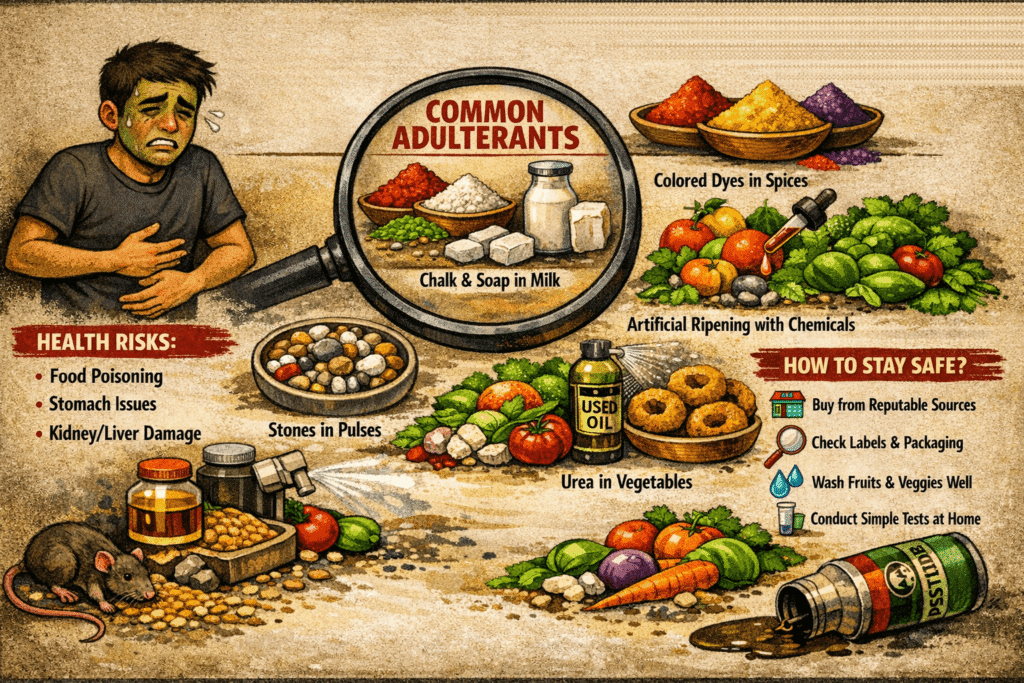
Food Adulteration in India – poison in every plate first shown on Taazakhabar News Every morning, millions of Indians begin their day with a glass of milk, a bowl of cereal, or a cup of tea. It is a ritual of nourishment and trust. Yet, as we move through 2026, a disturbing reality has become impossible to ignore: the very food meant to sustain the nation is increasingly being weaponized by greed. From “fake” paneer crafted from sulphuric acid and urea to festive sweets laced with carcinogenic dyes, food adulteration in India has evolved from a sporadic nuisance into a systemic public health emergency. It is, quite literally, a poison for every season and every reason. Food adulteration in India has evolved into a systemic public health crisis and a violation of fundamental human rights, particularly the Right to Life under Article 21. Global evidence reinforces the urgency: WHO estimates 600 million cases of foodborne illnesses annually, causing 420,000 deaths worldwide 33 million DALYs (Disability-Adjusted Life Years) lost annually due to unsafe food Children under 5 account for 30% of deaths India’s own regulatory data shows persistent non-compliance rates (~20–25%) in food samples annually, indicating structural failure rather than isolated violations. The Scale of a Shadow Industry The scale of this crisis is staggering. Despite a robust legislative framework and a flurry of recent reforms, the “poison on our plates” continues to proliferate. In the fiscal year 2024-25, the Food Safety and Standards Authority of India (FSSAI) and state agencies analyzed over 170,000 food samples. The results were harrowing. In several populous states, nearly one-third of samples tested during specific surveillance drives were found to be non-compliant, with a significant portion categorized as “unsafe” rather than just “substandard.” Modern adulteration is no longer just about diluting milk with water or adding pebbles to rice. It has become a high-tech criminal enterprise. We see “synthetic” milk manufactured from caustic soda and cheap oil; palm oil masquerading as mustard oil through deceptive labeling; and neurotoxic brighteners used to make stale vegetables look “farm fresh.” This is a multi-billion-dollar shadow industry that thrives on the anonymity of the unorganized sector, which still constitutes the vast majority of India’s food supply chain. A Poison for Every Season In India, the nature of the poison changes with the calendar. Adulteration is opportunistic, mapping itself onto our cultural and biological needs: Festive Surge: During Diwali, Holi, and Eid, the demand for milk-based sweets (khoya and mava) skyrockets. This is the peak season for “fake” dairy. Seizures in 2025 revealed massive quantities of khoya made from recycled surgical cotton and hazardous chemicals. Summer Heat: As temperatures soar, the demand for refreshing drinks and ice creams peaks. This is when we see the highest incidence of non-permitted synthetic colors and industrial-grade ice being used in street beverages, leading to seasonal outbreaks of typhoid and hepatitis. Monsoon Risks: During the rainy season, when the risk of contamination is naturally high, unscrupulous traders use heavy doses of antibiotics and formaldehyde to artificially extend the shelf life of fish and poultry. Daily Staple: Even the “reasons” for eating are compromised. Whether it is turmeric for its medicinal properties (often laced with lead chromate) or honey for weight loss (frequently stretched with inverted sugar syrup), the very items we consume for health are becoming the vectors for disease. Why the System Stutters: The Enforcement Gap If India has the laws—primarily the Food Safety and Standards Act of 2006—why does the problem, persist? The answer lies in the chasm between legislation and ground-level enforcement. Resource Paralysis: India’s expenditure on food safety is a fraction of what is required. Currently, the budget allocation for food safety monitoring is roughly 0.02% of the health budget. This manifests as a critical shortage of manpower; many districts have only one Food Safety Officer (FSO) for hundreds of thousands of food business operators. The “Paper Tiger” Syndrome: While thousands of violations are recorded annually, actual punitive action is often negligible. Government data shows that while fines have increased, the actual cancellation of licenses is rare. For a wealthy manufacturer, a fine is often seen as merely a “cost of doing business” rather than a reason to reform. The Unorganized Maze: A significant portion of India’s food—from street vendors to local flour mills—operates outside the formal regulatory net. Monitoring millions of micro-entrepreneurs is a logistical nightmare that traditional “command-and-control” regulation is ill-equipped to handle. The 2026 Reforms: A Double-Edged Sword In early 2026, the Union Health Ministry and FSSAI announced a suite of major regulatory reforms. These changes signal a shift toward “Ease of Doing Business,” but their impact on food safety is a subject of intense debate. The introduction of Perpetual Validity for licenses and registrations is a controversial pillar of this new era. By eliminating the need for periodic renewals, the government aims to reduce corruption and red tape. However, critics argue that the renewal process was one of the few times a business was forced to undergo a formal review. To counter this, the FSSAI has shifted toward a Risk-Based Inspection System (RBIS). Under this framework, high-risk categories like dairy, meat, and infant food are prioritized for frequent, computer-scheduled audits, while low-risk businesses face less frequent intrusion. While theoretically sound, the success of this system depends entirely on the integrity of the data and the honesty of the inspectors. Technology: The Final Frontier? If the human element of enforcement is stretched thin, technology must fill the gap. We are seeing promising strides in this area, but they require scaling: Food Safety on Wheels (FSW): There are now over 350 mobile testing labs deployed across India. These units bring testing directly to local markets, providing “on-the-spot” results that can deter local adulterators and educate the public. This is in my view minuscule for a population of 1.4 billion citizens. We should have mobile testing vans in every block of the country and to make that happen we should have at least 7323 testing vans in the country. Digital Traceability: There is an urgent need to mandate QR-code-based traceability for high-risk items like edible oils and

Food Adulteration in India – poison in every plate Read More »