Jago Grahak Jago

Edit Template

April 2026

Product Labels: What They Reveal – And What They Don’t

The Art of Showing Just Enough While Hiding the Rest Product labels serve as the initial connection between consumers and purchased items. Beyond decoration, they enable brand recognition while helping consumers distinguish between quality products and substandard ones. However, labels frequently conceal rather than reveal information. “If labels told the whole truth, 80-90% Marketing Managers might be out of their job.” What Labels Should Provide Product name and manufacturer identity Complete ingredient lists and nutritional information Usage instructions and expiration dates Health and safety warnings QR codes for additional product information Batch/lot numbers for production history tracing Questionable Marketing Terms “Natural” – Lacks standardized definition in many countries including India. Products may contain artificial additives or preservatives. “Organic” – Requires certification demanding 95% or higher organic ingredient content from bodies like USDA Organic or India Organic. “Sugar-Free” – Products may still contain sugar alcohols or artificial sweeteners. Regulations allow less than 0.5 grams per serving. “Clinically Proven” – A marketing term lacking uniform definition. Companies may conduct small-scale or biased studies. Indian Examples of Misleading Labels Patanjali’s Putrajeevak Beej: Marketing claims of infertility treatment sparked legal scrutiny Nestle’s Maggi Noodles: 2015 FSSAI controversy revealed excessive lead despite “No added MSG” labeling Cadbury’s Bournvita: High sugar and artificial colorants despite health benefit claims A2 Milk and Ghee: Premium-priced products lacked scientific evidence; FSSAI banned A2 labeling without proven benefits Global Examples Barilla Pasta: “Italy’s #1 Brand” when U.S. facilities produced most American-sold products H&M Greenwashing: Marketed conventional cotton as organic without substantiation Low-Fat Foods: High sugar compensation makes these deceptively unhealthy India’s Supreme Court recently mandated states establish advertising monitoring cells to combat misleading advertisements. Consumers must read beyond marketing claims to verify actual product composition.

Product Labels: What They Reveal – And What They Don’t Read More »

Regulators on Trial: Are Regulators in India Living Up to the Expectations of the Consumers?

When Systems Fail the People They Serve India has established multiple regulatory bodies – the RBI for banking, IRDAI for insurance, RERA for real estate, CCPA for consumer affairs, TRAI for telecom, FSSAI for food safety, CDSCO for pharmaceuticals, and DGCA for aviation. However, complaint volumes tell a different story. The National Consumer Helpline received over 83,000 complaints in 2022-23, approximately 102,000 in 2023-24, and more than 107,000 in the first quarter of 2024-25. Success Cases: When Regulations Function Real Estate: In Gurugram’s Chintels Paradiso project, Haryana RERA ordered developers to refund over Rs 1.7 crore including 11% annual interest plus compensation. Digital Lending: RBI’s guidelines forced hundreds of lending applications to either register properly or cease operations, with proposed legislation criminalizing unregulated lending with imprisonment up to seven years. The Implementation Gap Real Estate Delays: Only 20% of group housing projects in Noida have cleared financial obligations; major developers like Unitech and Amrapali collectively owe tens of thousands of crores. Insurance Mis-selling: Investment products marketed as “guaranteed” deposits, complex ULIPs sold to elderly customers requiring basic protection. Banking Problems: Consumers encounter obscure fees, unilateral contract modifications, and aggressive collection practices despite RBI oversight. Structural Limitations Systemic Stability Priority: Regulators prioritize institutional solvency over individual consumer protection Resource Constraints: Rapidly expanding caseloads exceed processing capacity Institutional Fragmentation: Digital fraud victims may navigate multiple entities without clear accountability Information Asymmetry: Contracts contain dense jargon with minimal plain-language guidance Recommendations Expedited resolution processes with cross-regulator task forces Meaningful deterrence through license revocation and public-capital-raising prohibitions Data-driven proactive supervision using real-time analytics Accessible Consumer Rights Charters at every bank and insurance counter Structured consumer participation through formal consumer councils India requires regulator mindset transformation, not institutional expansion. Success measurement should shift from institutional balance-sheet protection to human-life-savings safeguarding.

Regulators on Trial: Are Regulators in India Living Up to the Expectations of the Consumers? Read More »

Palm Oil: The Invisible Ingredient in India’s Snack Revolution

The Hidden Fat in Your Favourite Snacks Palm oil has become ubiquitous in India’s processed food industry, often disguised under vague labeling like “vegetable oil” or “blended edible oil.” This ingredient has fundamentally altered food manufacturing economics while raising significant health and environmental concerns. Why Manufacturers Prefer Palm Oil Manufacturers favor palm oil for three primary reasons: cost efficiency, extended shelf life, and desirable texture properties. Its high oxidative stability means products stay fresh longer, while it simultaneously helps maintain profit margins through affordability. Indonesia and Malaysia supply India’s imports at competitive prices. Health Implications Palm oil contains approximately 50% saturated fat, primarily palmitic acid, linked to elevated LDL cholesterol. The genuine danger emerges with repeatedly heated oil, which generates trans fats and aldehydes causing inflammation and cardiovascular harm. Small-scale Indian snack manufacturers frequently reuse frying oil, magnifying these risks substantially. Common Product Applications Chips, namkeen, instant noodles, and biscuits all rely heavily on palm oil. It serves as the frying medium, provides texture in pre-fried noodle blocks, and replaces costlier ingredients like butter in biscuits. Each product delivers several grams of palm oil-derived fat, contributing to obesity and heart disease prevalence. Environmental Concerns Palm oil cultivation has driven deforestation across Indonesia and Malaysia, destroying habitats for endangered species including orangutans and Sumatran tigers. Less than one-fifth of India’s imports meet sustainable certification standards (RSPO). How to Spot Palm Oil on Labels Palm oil / Palmolein Hydrogenated vegetable fat Vegetable oil blend Palm kernel oil Edible vegetable oil (unspecified) While palm oil enables affordable food for millions, it simultaneously contributes to lifestyle diseases and environmental degradation. The challenge involves wise usage, strict regulation, and consumer education rather than outright prohibition.

Palm Oil: The Invisible Ingredient in India’s Snack Revolution Read More »

Food Adulteration in India: Poison in Every Plate

A Silent Crisis on Every Indian Table Millions of Indians consume milk, cereal, and tea daily as a ritual of nourishment and trust. Yet food meant to sustain the nation is increasingly being weaponized by greed. From fake paneer made with sulphuric acid to festive sweets containing carcinogenic dyes, food adulteration is a systemic public health crisis violating Article 21 rights. WHO statistics show 600 million annual foodborne illness cases globally with 420,000 deaths. The Scale of a Shadow Industry During 2024-25, over 170,000 food samples tested by authorities showed nearly one-third of samples in several states were non-compliant. Modern adulteration has evolved beyond simple water dilution, becoming a multi-billion-dollar shadow industry involving synthetic milk, mislabeled palm oil, and neurotoxic brighteners on vegetables. A Poison for Every Season Festive periods see fake dairy products surge during Diwali, Holi, and Eid Summer months bring synthetic colors and contaminated beverages causing typhoid and hepatitis Monsoon season involves antibiotics and formaldehyde extending shelf-life artificially Daily consumption includes turmeric laced with lead chromate and honey mixed with sugar syrup Why the System Stutters: The Enforcement Gap Three critical failures undermine the Food Safety and Standards Act of 2006: Resource shortage: Food safety receives roughly 0.02% of the health budget, leaving many districts with just one Food Safety Officer Weak penalties: Fines function as business costs rather than deterrents; license cancellations remain rare Unorganized sector gaps: Millions of micro-entrepreneurs operate outside regulatory reach The 2026 Reforms: A Double-Edged Sword Recent government initiatives introduced Perpetual Validity for licenses, eliminating renewal reviews. Simultaneously, the Risk-Based Inspection System prioritizes high-risk categories like dairy and infant food for frequent audits while reducing scrutiny of lower-risk businesses. Technology: The Final Frontier Food Safety on Wheels: Over 350 mobile testing labs operate across India, though the author advocates for 7,323 units nationally Digital traceability: QR-code systems for high-risk items like oils and honey DART initiative: Consumer-accessible rapid testing kits enabling household detection of adulterants The Path Forward: A Multi-Pronged Strategy Indexing fines to company turnover with imprisonment for hazardous substance use Tripling Food Safety Officers and upgrading laboratories Incentivizing compliance through certification programs Empowering consumers as food auditors through label checking and FSSAI utilization Food adulteration operates as a silent killer with long-term health consequences including renal failure and cancer. Safe food must be recognized and enforced as a non-negotiable fundamental right.

Food Adulteration in India: Poison in Every Plate Read More »

Palm Oil: The Invisible Ingredient in India’s Snack Revolution

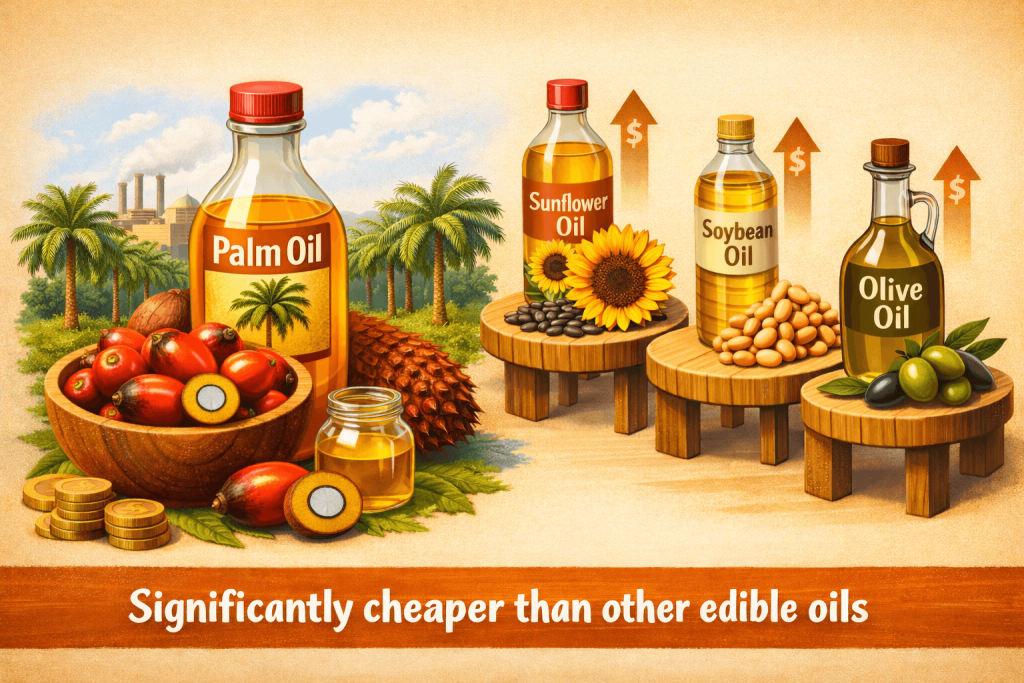
Palm Oil: The Invisible Ingredient in India’s Snack Revolution first shown on Taazakhabar News How ultra-cheap palm oil has quietly taken over the Indian processed food shelf — and what that means for health and the environment Walk down any supermarket aisle in India and you’ll find a common thread running through chips, namkeen, instant noodles, biscuits, and even frozen snacks — palm oil. It’s rarely mentioned upfront, often hidden behind vague labels like “vegetable oil” or “blended edible oil.” Yet, this single ingredient has reshaped the economics of India’s food industry and the health profile of its consumers. Palm oil’s rise is no accident. It’s the world’s most efficient oil crop, yielding far more per hectare than soybean or sunflower. For manufacturers, it’s a dream come true — cheap, stable, and versatile. For consumers, it’s a silent ingredient in every processed food they eat. Why Manufacturers Love Palm Oil Palm oil’s dominance is rooted in economics. India imports millions of tonnes annually, mostly from Indonesia and Malaysia, where vast plantations churn out oil at rock-bottom prices. For food companies, it offers several irresistible advantages. First, cost. Palm oil is significantly cheaper than other edible oils, allowing manufacturers to keep prices low while maintaining profit margins. Second, shelf life. Its high oxidative stability means products stay fresh longer, resisting rancidity even in India’s humid climate. Third, texture and taste. Palm oil gives biscuits their crunch, noodles their crispness, and namkeen its golden hue — all without altering flavour. In short, palm oil helps manufacturers deliver consistency, affordability, and longevity — the holy trinity of mass-market food production. The Health Debate: Saturated Fat and Oxidised Oil Palm oil’s nutritional profile, however, is far less flattering. It contains roughly 50% saturated fat, primarily palmitic acid — the same compound linked to elevated LDL cholesterol and heart disease. For decades, nutritionists have warned against excessive consumption of saturated fats, urging a shift toward unsaturated oils like sunflower or mustard. But the debate has evolved. Some researchers argue that palm oil, when consumed in moderation and not repeatedly heated, may not be as harmful as once believed. They point to its natural antioxidants — tocotrienols, a form of vitamin E — which may offer protective benefits. Others note that traditional diets in Southeast Asia have included palm oil for generations without epidemic levels of heart disease. The real danger lies in oxidised palm oil — oil that’s been reheated multiple times, as in deep-frying. When exposed to high temperatures repeatedly, palm oil forms trans fats and aldehydes, compounds known to trigger inflammation and cardiovascular damage. In India’s small-scale snack factories and street stalls, where oil reuse is common, this risk is magnified. Case Study: Chips, Namkeen, Instant Noodles, and Biscuits Palm oil’s fingerprints are everywhere. In chips and namkeen, it’s the frying medium of choice, prized for its stability and cost. In instant noodles, it’s used to pre-fry the noodle blocks, giving them their signature texture. In biscuits, it’s the fat that binds dough and fills cream layers, replacing costlier butter or ghee. Each of these products delivers convenience and taste — but also a hidden dose of saturated fat, which is highly hazardous to the health of the consumer. A single packet of chips or a handful of biscuits can contain several grams of palm oil-derived fat, contributing to India’s growing burden of obesity and heart disease. The irony is that palm oil’s neutrality makes it invisible. It doesn’t smell, doesn’t taste, and doesn’t announce itself. Consumers rarely realise how much they’re consuming until they start reading labels closely or are victims of Non-communicable diseases. The Environmental Cost: Forests for Food Beyond health, palm oil carries a heavy environmental footprint. Its cultivation has driven deforestation across Indonesia and Malaysia, destroying habitats of endangered species like orangutans and Sumatran tigers. Peatland burning releases vast amounts of carbon dioxide, making palm oil production a major contributor to global greenhouse emissions. India’s appetite for cheap palm oil indirectly fuels this destruction. While sustainable palm oil certification (RSPO) exists, less than a fifth of India’s imports meet these standards. The rest comes from plantations linked to deforestation, land conflicts, and biodiversity loss. India is not behind such environmental issues. We find huge chunks of land in Southern States getting converted into palm oil cultivation and the States are not regulating such practices adopted by the farmers. The paradox is stark: palm oil helps feed millions affordably but undermines the ecological systems that sustain life itself and at the cost of health and safety of the citizens. Moderation and the Middle Ground Nutrition science rarely deals in absolutes. Palm oil isn’t poison, nor is it a healthy food. The key lies in moderation and diversity. Using palm oil occasionally, alongside other oils like mustard, sesame, or rice bran, can balance fatty acid intake. The problem arises when palm oil becomes the default — as it has in India’s processed food industry. Public health experts now urge consumers to limit processed foods rather than demonise a single ingredient. The focus should shift from palm oil itself to the broader pattern of ultra-processed diets, which combine refined carbs, sugars, and fats in addictive proportions. How to Spot Palm Oil on Labels Palm oil hides behind multiple aliases. To identify it, look for these clues on packaging: Palm oil / Palmolein: Common in fried snacks and instant noodles. Hydrogenated vegetable fat: Often palm-based shortening used in biscuits and bakery items. Vegetable oil blend: Usually a mix of palm and soybean or sunflower oil. Palm kernel oil: Derived from the seed, richer in saturated fat, used in cream fillings and chocolates. Edible vegetable oil (unspecified): A generic term that often masks palm oil’s presence. If the label doesn’t specify the oil type, assume palm oil is part of the blend. Transparency remains a major gap in India’s food laws, leaving consumers to decode vague terminology. The Consumer’s Role: Awareness and Action Palm oil’s ubiquity makes avoidance difficult, but awareness is the

Palm Oil: The Invisible Ingredient in India’s Snack Revolution Read More »

Food Adulteration in India – poison in every plate

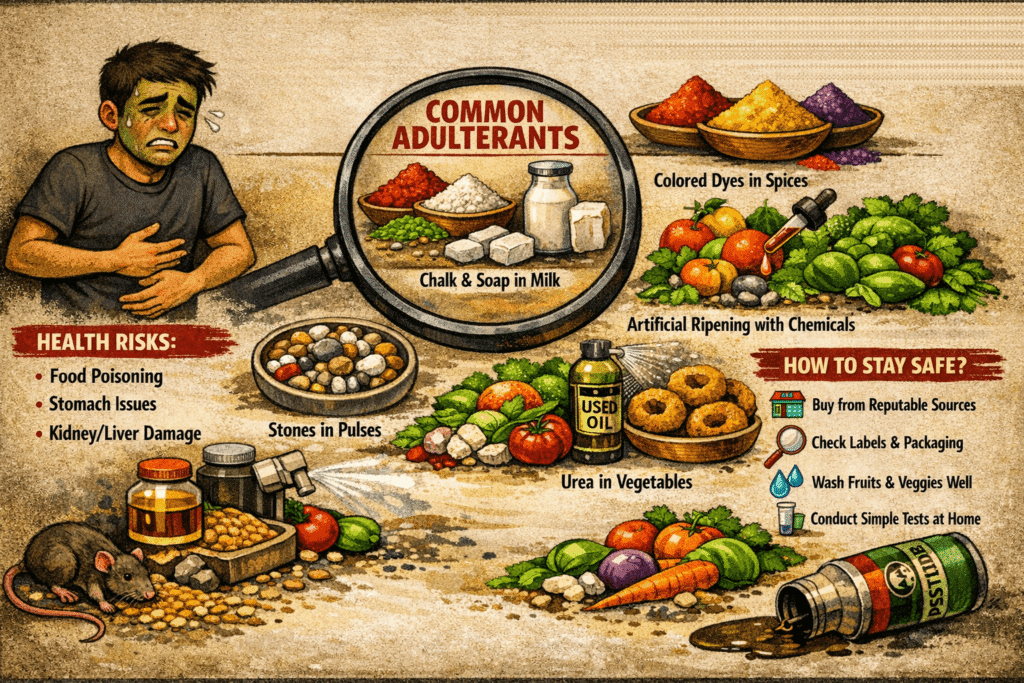
Food Adulteration in India – poison in every plate first shown on Taazakhabar News Every morning, millions of Indians begin their day with a glass of milk, a bowl of cereal, or a cup of tea. It is a ritual of nourishment and trust. Yet, as we move through 2026, a disturbing reality has become impossible to ignore: the very food meant to sustain the nation is increasingly being weaponized by greed. From “fake” paneer crafted from sulphuric acid and urea to festive sweets laced with carcinogenic dyes, food adulteration in India has evolved from a sporadic nuisance into a systemic public health emergency. It is, quite literally, a poison for every season and every reason. Food adulteration in India has evolved into a systemic public health crisis and a violation of fundamental human rights, particularly the Right to Life under Article 21. Global evidence reinforces the urgency: WHO estimates 600 million cases of foodborne illnesses annually, causing 420,000 deaths worldwide 33 million DALYs (Disability-Adjusted Life Years) lost annually due to unsafe food Children under 5 account for 30% of deaths India’s own regulatory data shows persistent non-compliance rates (~20–25%) in food samples annually, indicating structural failure rather than isolated violations. The Scale of a Shadow Industry The scale of this crisis is staggering. Despite a robust legislative framework and a flurry of recent reforms, the “poison on our plates” continues to proliferate. In the fiscal year 2024-25, the Food Safety and Standards Authority of India (FSSAI) and state agencies analyzed over 170,000 food samples. The results were harrowing. In several populous states, nearly one-third of samples tested during specific surveillance drives were found to be non-compliant, with a significant portion categorized as “unsafe” rather than just “substandard.” Modern adulteration is no longer just about diluting milk with water or adding pebbles to rice. It has become a high-tech criminal enterprise. We see “synthetic” milk manufactured from caustic soda and cheap oil; palm oil masquerading as mustard oil through deceptive labeling; and neurotoxic brighteners used to make stale vegetables look “farm fresh.” This is a multi-billion-dollar shadow industry that thrives on the anonymity of the unorganized sector, which still constitutes the vast majority of India’s food supply chain. A Poison for Every Season In India, the nature of the poison changes with the calendar. Adulteration is opportunistic, mapping itself onto our cultural and biological needs: Festive Surge: During Diwali, Holi, and Eid, the demand for milk-based sweets (khoya and mava) skyrockets. This is the peak season for “fake” dairy. Seizures in 2025 revealed massive quantities of khoya made from recycled surgical cotton and hazardous chemicals. Summer Heat: As temperatures soar, the demand for refreshing drinks and ice creams peaks. This is when we see the highest incidence of non-permitted synthetic colors and industrial-grade ice being used in street beverages, leading to seasonal outbreaks of typhoid and hepatitis. Monsoon Risks: During the rainy season, when the risk of contamination is naturally high, unscrupulous traders use heavy doses of antibiotics and formaldehyde to artificially extend the shelf life of fish and poultry. Daily Staple: Even the “reasons” for eating are compromised. Whether it is turmeric for its medicinal properties (often laced with lead chromate) or honey for weight loss (frequently stretched with inverted sugar syrup), the very items we consume for health are becoming the vectors for disease. Why the System Stutters: The Enforcement Gap If India has the laws—primarily the Food Safety and Standards Act of 2006—why does the problem, persist? The answer lies in the chasm between legislation and ground-level enforcement. Resource Paralysis: India’s expenditure on food safety is a fraction of what is required. Currently, the budget allocation for food safety monitoring is roughly 0.02% of the health budget. This manifests as a critical shortage of manpower; many districts have only one Food Safety Officer (FSO) for hundreds of thousands of food business operators. The “Paper Tiger” Syndrome: While thousands of violations are recorded annually, actual punitive action is often negligible. Government data shows that while fines have increased, the actual cancellation of licenses is rare. For a wealthy manufacturer, a fine is often seen as merely a “cost of doing business” rather than a reason to reform. The Unorganized Maze: A significant portion of India’s food—from street vendors to local flour mills—operates outside the formal regulatory net. Monitoring millions of micro-entrepreneurs is a logistical nightmare that traditional “command-and-control” regulation is ill-equipped to handle. The 2026 Reforms: A Double-Edged Sword In early 2026, the Union Health Ministry and FSSAI announced a suite of major regulatory reforms. These changes signal a shift toward “Ease of Doing Business,” but their impact on food safety is a subject of intense debate. The introduction of Perpetual Validity for licenses and registrations is a controversial pillar of this new era. By eliminating the need for periodic renewals, the government aims to reduce corruption and red tape. However, critics argue that the renewal process was one of the few times a business was forced to undergo a formal review. To counter this, the FSSAI has shifted toward a Risk-Based Inspection System (RBIS). Under this framework, high-risk categories like dairy, meat, and infant food are prioritized for frequent, computer-scheduled audits, while low-risk businesses face less frequent intrusion. While theoretically sound, the success of this system depends entirely on the integrity of the data and the honesty of the inspectors. Technology: The Final Frontier? If the human element of enforcement is stretched thin, technology must fill the gap. We are seeing promising strides in this area, but they require scaling: Food Safety on Wheels (FSW): There are now over 350 mobile testing labs deployed across India. These units bring testing directly to local markets, providing “on-the-spot” results that can deter local adulterators and educate the public. This is in my view minuscule for a population of 1.4 billion citizens. We should have mobile testing vans in every block of the country and to make that happen we should have at least 7323 testing vans in the country. Digital Traceability: There is an urgent need to mandate QR-code-based traceability for high-risk items like edible oils and

Food Adulteration in India – poison in every plate Read More »

MRP Decoded: What Every Consumer Should Know

MRP Decoded: What Every Consumer Should Know An Interview with RAJIV NATH, Forum Coordinator, AiMeD Most of us glance at the MRP on a product without thinking twice. But, behind that tiny, printed number lies a big story – one that affects how much we pay, how businesses behave and how fairly the market treats consumers. To help simplify this, The Aware Consumer spoke to Rajiv Nath, Forum Coordinator of AiMeD, who has been championing fair pricing and ethical practices in India's medical devices sector. Here, he breaks down the MRP puzzle in simple, relatable terms. Q. MRP was originally introduced as a consumer protection measure. In today's market environment, do you think it still serves that purpose effectively? Yes, it does. Think of MRP as a 'speed limit' for prices – no shop can legally go above it. In medical devices, this is especially important because people often buy them in emergencies or in places with limited choices. Q. With the rise of e-commerce and dynamic pricing, is the concept of a printed MRP becoming outdated? Not really. Online prices may jump around, but the printed MRP acts like a safety net. It ensures there's always a maximum price, especially for essentials like thermometers, BP monitors or insulin syringes. Q. Consumers often judge value based on the difference between the MRP and the actual selling price. How does this perception influence pricing strategies? A big discount makes people feel as if they are getting a steal – even if the MRP was inflated. For example, an oxygen mask with an MRP of ₹2,000 sold for ₹200 looks like a huge bargain, but the real value may only be ₹200. Q. Some manufacturers set very high MRPs to create the appearance of large discounts. What are your thoughts on this practice and its impact on the consumers? It's like calling a ₹50 pen a ₹500 pen and then shouting “90% OFF!” It misleads consumers and destroys trust. In healthcare, where people can possibly buy under stress, this is especially unfair. Q. Critics argue that MRP can discourage price competition among retailers. Do you think the system inadvertently promotes uniform pricing? While the Maximum Retail Price (MRP) ensures a cap on how much consumers can be charged, its effect on actual pricing varies across different sectors. In some cases, strict adherence to MRP leads to near uniform pricing among sellers, limiting the scope for price competition. However, this dynamic shifts noticeably in online marketplaces, where vendors often set prices below the MRP to attract and retain customers. This practice fosters active competition and allows buyers to benefit from reduced prices. In contrast, the scenario is different in corporate hospitals and retail pharmacies. These establishments tend to stock medical device brands with higher MRPs, which translate into larger profit margins for sellers. Patients, especially those seeking medical devices, rarely encounter alternative choices or competing brands, resulting in a lack of price transparency. This limited availability creates a marketplace imbalance, discouraging genuine price competition and leaving consumers with fewer options. As a result, patients may end up paying more, without access to competitive pricing or the ability to compare products based on value. Q. Does MRP restrict pricing flexibility for businesses, especially in a highly competitive market? A bit, yes. Once printed, the MRP can't be changed easily. If costs rise or fall suddenly, businesses can't adjust quickly. It's like being stuck with last season's price tag. Q. What reforms could make the MRP system more realistic and effective? A simple, powerful fix is what we have long recommended: Cap trade margins based on the import‑landed price, not on an inflated MRP. Why? Because some products enter India at ₹100 but apply an MRP of ₹1,000 just to offer huge margins to hospitals or retailers. This pushes hospitals to choose the product with the highest margin, not the best quality or best price as best value for patients. If margins are capped on the real cost, hospitals will choose based on quality, safety and value – which is exactly what patients deserve. Q. Should India move towards a system based more on Suggested Retail Price (SRP) rather than mandatory MRP? For many products, a Suggested Retail Price (SRP) could work well. It gives guidance as well as allows healthy competition. But, for essential medical devices – like insulin syringes, oximeters or BP monitors – MRP still protects patients from being overcharged. Q. What are your thoughts on the government's recent proposal to link MRP to reasonable costs plus margins? Although the idea seems reasonable, it is not practical or effective when applied in reality. Previous efforts in the pharmaceutical industry have mostly failed because there were no consistent and fair reviews of pricing and compensation between regulators and manufacturers. As a result, many manufacturers stopped producing medicines at unsustainable prices or compromised on input quality and manufacturing processes to stay afloat. This ultimately reduced consumers' access to high-quality medicines from reputable manufacturers. Q. Do you believe the MRP system will remain relevant in the future or will pricing transparency evolve in different ways? Yes, but it will evolve. We may see digital MRPs, QR‑based price checks and more transparent online pricing. But the core idea – protecting consumers from overcharging – will always matter. Q. What message would you like to convey to the readers? India needs ethical manufacturers who genuinely want to offer good‑quality, affordable alternatives to expensive imported brands. But, unlike buying a TV or mobile phone – where you can compare prices, shop around and negotiate – patients in hospitals rarely get that choice. Hospitals often push medical devices at full MRP without offering any discounts and prefer brands that give them the highest margins. This sidelines ethical Indian manufacturers who offer fairer, lower‑MRP products. This is why we strongly advocate capping trade margins based on the real import‑landed price. It levels the playing field, encourages hospitals to choose products for quality rather than margin, and ensures patients get

MRP Decoded: What Every Consumer Should Know Read More »