
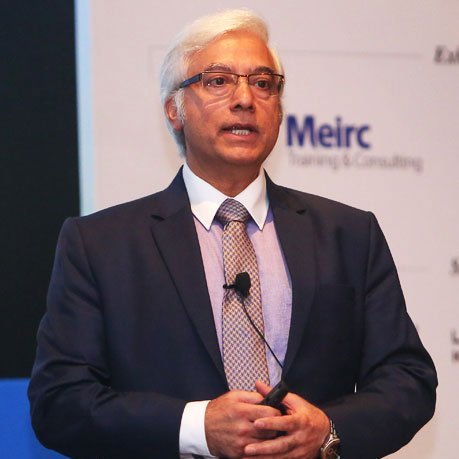
Mr. BHARAT WAKHLU, FASQ; FAIMA
Founder and President of 'The Wakhlu Advisory' – a strategic global consulting and leadership coaching firm
Mr Bharat's professional journey spans over 4 decades, distinguished by his 30 year association with the iconic Tata Group. Beginning his career as a Tata Administrative Service (TAS) executive in Tata Steel, he rose through the ranks to serve as Resident Director of Tata Sons in New Delhi. Throughout this period, Mr Bharat catalysed Total Quality and transformational growth across diverse businesses, grounded in ethical leadership and sustained value creation.
Mr Bharat is a first-class mechanical engineer from BITS Pilani and a postgraduate from IIM Bangalore. An acclaimed Fellow of the American Society for Quality and the All-India Management Association, he has authored 8 books, including 'Total Quality: Excellence Through Organisation-wide Transformation'.
Today, Mr Bharat is a sought-after leadership coach and a facilitator for strategic business transformation and innovation. Through FPACL, he is actively advancing leadership development and skills enhancement for women, youth and the underserved, helping them realise their highest potential.
Co-founder of the not-for-profit 'Foundation for Peace and Compassionate Leadership' (FPACL)
Quality is best defined as 'fitness for use'. If a product (or a service) meets the entire range of performance expectations of consumers in the right manner and at a price that is generally considered competitive for the value offered, that product would be deemed to be of the appropriate quality.
Consumers with the same 'wants', which remain consistent over time, can be clubbed together into what may be termed a 'market'. A market, when accessing quality goods (or services), will need to ensure that the offerings from the producers meet all their performance expectations at all times, consistently. Then, if all the competing goods serving that market meet the 'fitness for use' test, specific, discerning consumers will apply the 'value filter': factoring in the price of the product, and determining which of the competing choices offers the most value. The product that provides the highest ratio between the perceived Quality (Q) and the offered Price (P), would be perceived as 'most valuable' by specific consumers. If they are rational buyers, they are likely to go for the product that provides the greatest value.
The theme for the World Quality Month, 2025 is an apt one – it suggests that Quality is an ever-moving target. As consumer expectations and aspirations continue to change rapidly over time, there is a need for producers of goods and services to continuously improve their offerings, the processes by which they do so and, more importantly, to innovate rapidly and leverage the advances in the diverse new technologies available, to deliver consistent, competitive value to consumers.
For India to promote 'quality' differently, we need to get our fundamentals right. Despite all the great work that has been done within public sector companies and private ones to enhance process and product quality, some serious lapses – in critical areas – remain. For instance, 'leadership' is one such critical area, without which 'quality' is relegated to the 'rank and file' rather than where it needs to begin: namely in Board Rooms. Leaders, especially at the top of their respective organisations, have to imbibe 'quality values' to drive their organisations to excellence and superior performance. Simple actions, such as ensuring punctuality at all times, a zero-tolerance for wrong-doing and any kind of corruption to cut corners or bypass compliance requirements, are imperative. Furthermore, 'Quality' cannot merely be confined to the premises of one's company or to one's home. I have visited companies where expensive products are made and where the premises are spotlessly clean. Yet, just beyond the walls of the company's factory, there is a garbage dump that has been there for years! This happens because executives don't see problems outside of an imaginary 'boundary' as their concern. This attitude needs to change.
That is why Indian leaders – across the board – have to start to 'think differently', and to realise why we, as a nation, have yet to make the phrase, 'Made in India' synonymous with outstanding quality in all spheres.
As I shared earlier, products or services that are considered to be of high quality must consistently meet all the performance expectations of all the customers who acquire such products or use the offered services. The key word here is: 'consistently' which implies that, over time, even as the aspirations of the consumers are changing, the organisations delivering the goods 'keep an ear to the ground' to listen to the feedback of their customers.
Many of the offerings that you have mentioned – healthcare, public transportation, insurance or banking – are delivered by organisations that do not have a culture of continuously capturing the voice of the customer. As a result, consumers of the services are short-changed – either because the product offered is 'unfit for use' or the processes by which the goods are offered leave the consumers unhappy and irritated.
Fortunately, these lapses are not intractable problems that do not have solutions. They call for committed leaders, who consciously want to delight their consumers, to make their organisations more customer-centric and responsive to customer aspirations. In the absence of such intentionality, the lapses will continue even as the consumers suffer.
The use of System Standards to ensure that the modicum elements of systems, processes and procedures are in place, so as to deliver the offerings that are being promised, has its place in the management of Quality. However, system standards, even when certified by the Quality Council of India (QCI), through its constituent arms mentioned, play only a limited role in delivering world-class quality, because it is an 'outsider in process'. A third-party is certifying what a hospital or a clinic or a lab are doing, or need to do. As we know, quality can never be 'inspected into' products or services. Instead, if the leadership of an enterprise or hospital considers the process of accreditation to a system to be the bare-minimum requirements to deliver world-class quality at all times, there can be an improvement.
As for empowering customers: the idea that some organisations might be preferred by consumers merely because of certification, is doubtful. There are many touch-points in organisations where customers interact with organisational representatives. Each of those touch-points has the power to determine the customer's experience and hence their perception of the entire organisation.
Yes, consumers should be alert and active! Even if a simple product of daily use, for instance, turns out to be defective or of poor quality, the manufacturer/distributor needs to be contacted (most do provide a customer-feedback number or an email) and either a replacement sought or one's money back. But, if a consumer has been the victim of a sub-standard quality lapse or a wilful fraud, including through e-commerce or online buying, then approaching the appropriate three-tiered consumer commissions (created as a part of the Consumer Protection Act, 2019) is essential.
The consumer court system provides a sound means for the redressal of quality complaints to duped consumers. But, here too, Indi's consumer grievance redressal system is so tardy and clogged up (another serious quality issue at the level of governance of the judiciary!) that manufacturers of goods as well as service providers, are not dismayed if a disgruntled customer files a complaint! Instead, they go about their business as if nothing has happened, and continue with their reprehensible performance.
As I mentioned earlier, it boils down to leadership and intentionality. If the tone at the top of an enterprise is wholesome and the enterprise articulates that it is committed to consistently produce goods that are world class and the kind that meet the needs of the most discerning consumers, consistently, it sets into motion all the positive behaviours that eventually show up as outstanding quality. Great leadership drives the kind of culture within enterprises that is essential for consistently producing world-class quality.
Firstly, as mentioned, standards and certifications play only a limited role, especially if the organisations also delegate the responsibility for compliance against the standards to a junior executive who has no access to the upper management team. Secondly, the mind-set of the leaders in organisations has to be oriented toward serving their chosen customers with commitment and passion. QCI, BIS and the food safety regulators (who manage the FSSAI) need to actively engage with the upper management of the firms that seek their services, rather than going about their process in a mechanical, bureaucratic way. If they attack the problems of quality at the level of upper management, it might shift the needle towards improved quality.
I have spent much of my professional life – both as an executive who is proficient in, and committed to Total Quality, and more recently, as a Strategic Consultant and Executive Coach – to determine the answer to this crucial question. My short answer is: get upright, committed, energetic, customer-oriented and quality-driven men and women leaders to lead enterprises. I don't just mean business enterprises: but all organisations, including those in government, in the states and in the Centre. That also implies, ensuring that all educational institutions – from schools, all the way to colleges and institutions of higher learning – make it mandatory to understand what it means to lead for quality and ethics. Future leaders (including the ones who come into the government through the UPSC) need to be screened thoroughly for their attitudes towards quality, ethics, collaboration and humility: and the most capable ones only should be given authority.
Countries such as Japan, which have consciously created a strong and deep culture of quality, have done so through sheer hard work, and an abiding commitment to Total Quality from the senior leadership teams and the operational-level executives of their leading corporations. In this, they were assisted by the renowned organisation, JUSE (the Union of Japanese Scientists and Engineers) founded in May 1946 by the Ministry of Science and Technology in Japan. The objectives for the formation of JUSE were not about 'quality' alone, but also about devising methods, processes and the talent that would help Japan to 'cope with the rapid advancement of [their] society'. The initiatives by JUSE were many, and continue to this day, albeit with changes, in keeping with the times.
Furthermore, it took Japan the better part of four decades after WWII to get to a level where they had a comprehensive grasp of the essential levers for a nation-wide commitment to Quality, excellence and a resilient, disciplined society.
I remember, when the QCI was conceived and then formed, it was to serve as a facilitator for precisely that kind of nation-wide transformation in India which JUSE brought about in Japan. Sadly, QCI lost the plot fairly early in its journey. However, the lesson that we need to learn – from Japan and other countries that have got their act together – is that inter-organisational collaboration and working – including with Government ministries – is imperative to solve tough, complex problems. Performance Excellence and Quality, in this age, also will need wilful and conscious collaboration between organisations, specialists, academia and business entities.
Building awareness across stakeholder groups is an important element of raising the quality consciousness across nations. When awareness increases and people understand what 'quality' stands for, consumers benefit from the better quality of goods and services offered. Eventually, the quality of life for all begins to improve. Consumers too understand how their expectations and aspirations mould the output of producers and that too contributes to overall societal value.
Promoting quality across society needs a coordinated effort, much like the JUSE has done in Japan. In India, an organisation – possibly attached to the Prime Minister's Office – that stimulates such cross-organisational collaboration with diverse entities would help considerably.